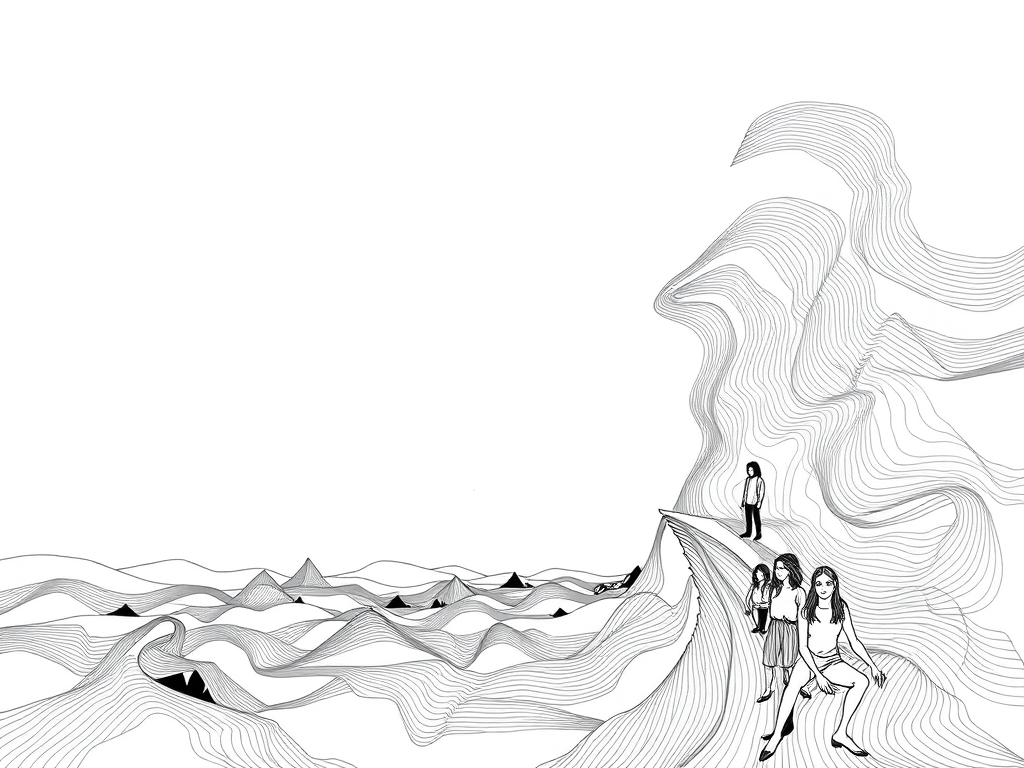
On unease, awareness and the new normal.
We are living through mad times. So mad that, these days, the truly strange ones are those who claim to be in perfect balance. Those who say, with conviction, that they need nothing at all — no therapy, no pause, no reflection. As if it were possible to move through the world as it is — wars, attacks, natural disasters, violence turned banal — without any internal fracture.
We are living through mad times. So mad that, these days, the truly strange ones are those who claim to be in perfect balance.
Every day, the media turn us into direct witnesses of insanity. Wars that have become routine for those watching from a distance. Tragedies like the one at the ski resort in Switzerland. Attacks on beaches, like the one in Australia. Successive natural disasters. The endless war of drug trafficking in Rio de Janeiro. The list goes on — relentless, exhausting, almost indifferent.
One minute we are watching images of death; the next, we are scrolling through Instagram, consuming human futility at its highest pitch. Life goes on. The coffee cools. The algorithm moves forward. We normalise the abnormal.
Life goes on. The coffee cools. The algorithm moves forward. We normalise the abnormal.
At the same time, it is also true that the world has never offered so many conveniences. Never has it been so possible — at least for some of us — to live a comfortable, functional, even happy life. And perhaps that is precisely where the danger lies: becoming too comfortable in a world that is burning.
I am not talking about guilt, nor about hysteria. I am talking about unease.
A certain degree of unease is necessary if we are not to turn into well-dressed zombies, emotionally anaesthetised, commenting on atrocities as casually as we comment on the weather. Unease enough to stop us from speaking about horror by rote, stripped of responsibility, empathy, or meaning.
A certain degree of unease is necessary if we are not to turn into well-dressed zombies, emotionally anaesthetised, commenting on atrocities as casually as we comment on the weather.
I am not referring to the kind of unease that implodes — the man who smashes up a shop, the one who enters a public space to kill, the fanatic who justifies violence in the name of an idea, a religion, a delusion. That kind of unease builds nothing. It only destroys.
I am talking about a smaller, but essential imbalance. A conscious discomfort. An internal friction that makes us pause, think, question. That prevents us from accepting this so-called new normal as acceptable.
Therapy can take many forms. It can be a couch, a difficult conversation, an honest journal, a long walk without distractions. It can be as simple as paying attention to oneself — something increasingly rare. Naming what unsettles us. Acknowledging the confusion. Admitting that something is not right, even when our lives, on the surface, appear to be.
Feeling discomfort is not weakness. It is lucidity. Proof that we are still awake.
It is often said: if you cannot change the world, start by changing yourself. And it is true — but more often than not, that is not what happens. In most cases, cruelty does not live only in distant wars or large systems. It lives next door. In petty envy, unnecessary whims, a profound lack of awareness, subtle violence, a complete absence of emotional responsibility.
That is why this unease matters. So that we may be conscious of the good, yes — but also of the bad. So that we do not become too comfortable in the midst of all this. So that we do not confuse survival with indifference.
A little unease each day. Enough not to let the world pass by without noticing that it is happening. Enough not to normalise madness. Enough that, even if we cannot fix everything, we refuse to disengage.
Because perhaps the true new normal should not be anaesthesia — but awareness.
 OBSERVATIONS & OTHER ACCIDENTS
Leave a comment