
Rain, a general strike, and every possible excuse to stay at home. Still, I went. What followed, at ModaPortugal, was less about fashion as spectacle, and more about observing an industry — and a generation — in the midst of becoming.
On December 11th, at around seven in the evening, the Palácio da Bolsa, in Porto, opened its doors to welcome the heart of the Portuguese textile industry, for another edition of ModaPortugal.
Not only was it raining, but there was also a general strike taking place — which meant heavy traffic and a certain degree of chaos across the city. The reasons to stay at home were, therefore, more than plentiful, especially considering that I am, by nature, not particularly fond of social gatherings. Still, I went. Despite the 40-minute Uber ride for a journey that would normally take around 15. And it was entirely worth it
Worth it not only for the striking grandeur of the Palácio itself, but also for the opportunity to briefly immerse myself in what is currently being done in Portugal within the textile industry. More than that, it offered a clearer sense of the scale of a sector that continues to stand firm, despite the difficulties and instability the fashion industry — as a global system — has faced in recent years.
After the initial impact, it becomes clear that this is not merely another event in the calendar. ModaPortugal brought together young designers from different European countries, as part of the MODAPORTUGAL LINKS competition — an initiative designed to bridge emerging creative talent and the Portuguese textile industry.

Throughout the event, accents, references and very different ways of looking at fashion intersected. Eighteen young designers took part, representing eight fashion schools from six countries, including Aalto University, the Institut Français de la Mode, Polimoda, the London College of Fashion and HEAD Genève, alongside several Portuguese institutions. The diversity was not only geographical; it was also conceptual, aesthetic and, in many cases, still in formation.
ModaPortugal brought together young designers from different European countries, as part of the MODAPORTUGAL LINKS competition.
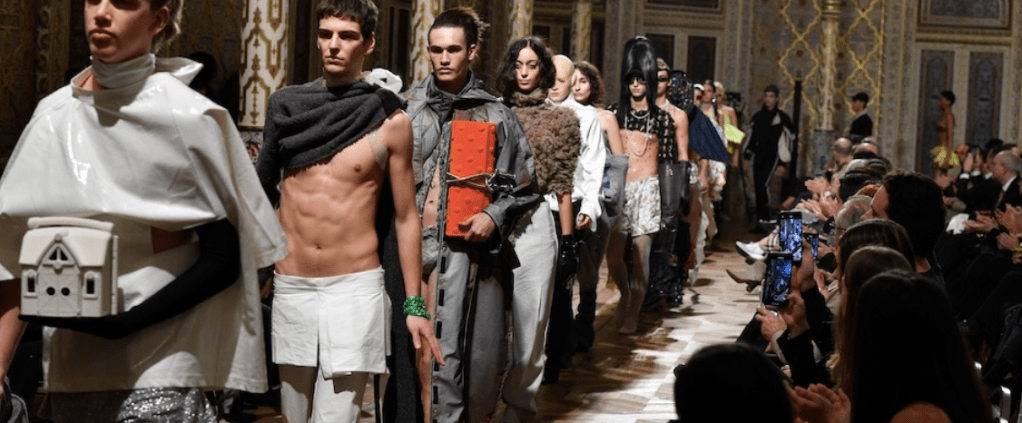
Final moments of the runway: all participants from the selected European fashion schools.
The industrial framework was ever-present. The competition, promoted by the Textile Intelligence Centre (CENIT) in partnership with the National Association of Apparel and Clothing Industries (ANIVEC/APIV), aimed to bring these young talents closer to the realities of production, placing themes such as sustainability, technological innovation and manufacturing methods at the centre of the conversation. A conversation that, at times, felt ambitious; at others, still clearly under construction.
There was enthusiasm, but also a certain tension. The expectation that fashion might “solve” structural problems coexisted with the clear reality that many of these designers are still discovering not only their aesthetic language, but also their place within a demanding, fast-paced and unforgiving system. The industry observes. Young designers listen. The dialogue is not always balanced — but it is, without doubt, necessary.
The closing ceremony, once again held at the Palácio da Bolsa, brought the event to an end with the presentation of awards and the familiar promise of the future. A future that, rather than being guaranteed, seems to depend on the ability of these talents to turn potential into consistency — and on the industry’s willingness to continue listening, not merely absorbing.

ModaPortugal thus fulfils its role as a platform: it exposes, connects and provokes. What remains afterwards — and what truly changes — is something only time will allow us to assess.


Leave a Reply