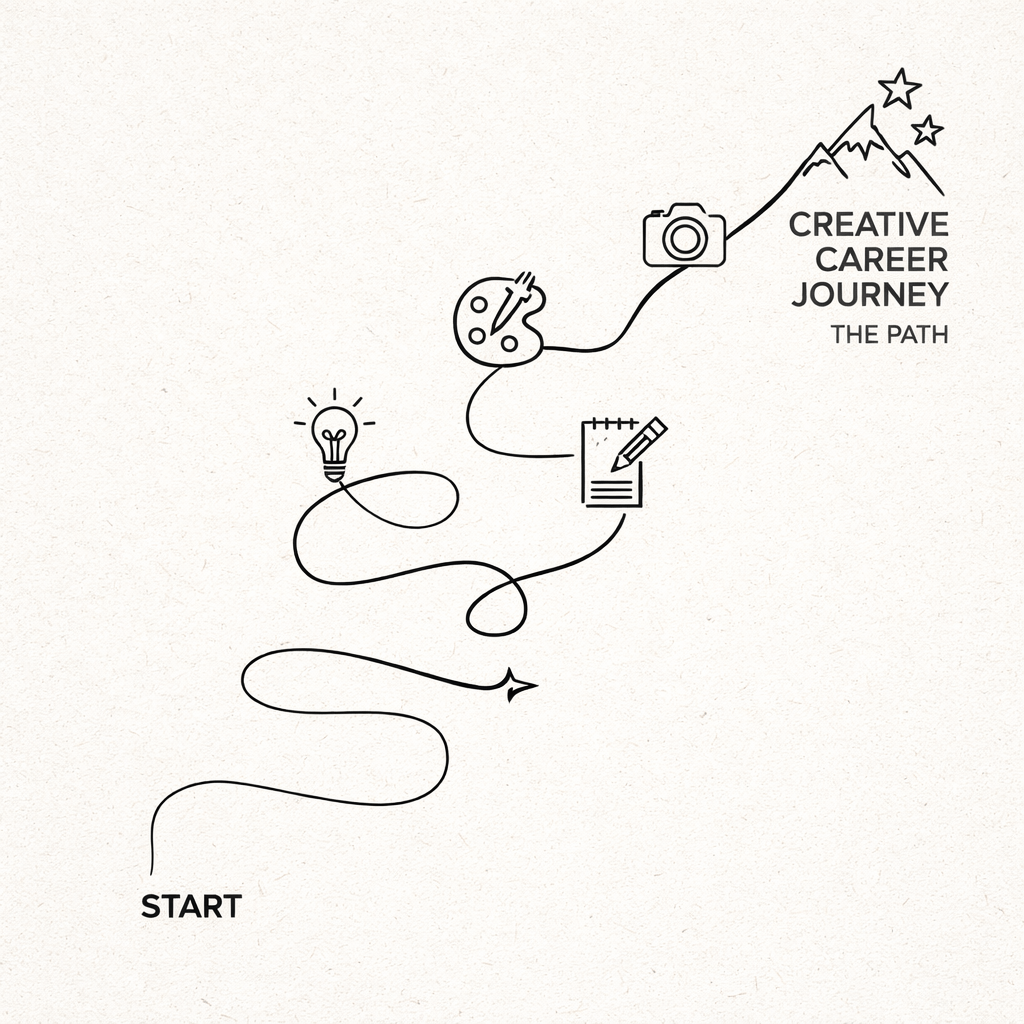
A career shaped by shifts, repetition, and refusal to stay still.
There is a question that has been following me around lately: how many times is too many to keep trying? I don’t have a fixed answer — I’m suspicious, in fact, of anyone who claims to. But I do have a path. And sometimes, looking back makes more sense than any neatly packaged theory.
I started at 20, as an intern at Ogilvy, and then moved through several advertising agencies as a copywriter — practically all the usual stops for anyone entering this field. I did the classic route — or what was meant to be a linear one. But I was never particularly good at drawing straight lines.
At the same time, I was writing about fashion. I always have. Above all because it has always been my natural space. I read magazines as if I were studying them, long before I knew this could become work. I began contributing here and there, often unpaid, because the goal was never immediate: it was to be inside it, to understand it, to learn. Later, I took a styling course and, without much of a strategic plan, began working as a stylist on editorials, including for titles such as GQ and other independent publications. Another layer, another attempt — a path that eventually led me to write continuously, for almost eight years now, as a regular contributor to Vogue.
On another track, there was a small detour into communications — a hiatus in my career that lasted exactly as long as it needed to. I worked with fashion and lifestyle brands, I was on the other side, the one that speaks to magazines, that tries to get into them. It brought me good things, important lessons, but it confirmed what, deep down, I already knew: it wasn’t my profile, nor the place where I felt aligned.
After that, the path took a more alternative direction. I worked on two editions of the Boom Festival, a project I loved working on and which, for me, was never just a job. It was almost a return to an essential part of my youth. My first Boom was in 2002, at a time when I never missed a single party, and returning there years later felt like closing a circle in an unlikely — and deeply right — way.
If I look at this journey from the outside, I understand what many saw: lack of focus. If I look at it from the inside, I see something else: a continuous desire to experiment, to expand, not to limit myself to a single version of who I am. In Portugal, I was often told this was not particularly well regarded; abroad, I heard the opposite — staying too long in one place could be seen as stagnation. Between these conflicting narratives, I did what I have always done best: I carried on.
If I look at this journey from the outside, I understand what many saw: lack of focus. If I look at it from the inside, I see something else: a continuous desire to experiment, to expand, not to limit myself to a single version of who I am.
I made mistakes — some of them quite practical. I never built a proper portfolio. I would finish one piece of work and immediately move on to the next, like a football team that neither lingers in celebration nor in disappointment: there is always another game. The result? A portfolio? I don’t have one, at least not in the conventional sense. But I have something else: years of accumulated experience, refined, internalised — an invisible archive that doesn’t fit into a PDF, but lives in everything I do.
And then came a phase of questioning. I don’t call it a crisis — I call it delayed clarity. A moment in which I began to look back over my twenties and thirties with a less indulgent and more strategic eye. It was there that I realised it was perhaps not a question of trying less, but of trying with more intention. Of channelling, condensing, transforming dispersion into proposition.
The result? A portfolio? I don’t have one, at least not in the conventional sense. But I have something else: years of accumulated experience, refined, internalised .
That is what I did with my new website. For the first time, I organised what I have always done instinctively into a clear offer, a language, a positioning.
As I write on my new site:
“I don’t do small talk. I believe in words that hit, that stick, that make you think. I help premium fashion, lifestyle, and luxury brands — and their founders — find a voice that is unmistakably theirs. From brand manifestos and campaign storytelling to long-form editorial, including my work for Vogue, I craft language that carries style, weight and intent. Founder private writing, verbal identity systems, editorial strategy — language that resonates, never empty.”
In a saturated market, where artificial intelligence writes for everyone and words have become fast, disposable, often indistinguishable, this may seem like a risk — and it is. But it is also a choice. Because there is a difference between writing and actually saying something. We see it every day: in campaigns that sound good but leave no trace, in polished speeches that could belong to any brand, in the world of influencers, where every scroll brings a new recommendation that disappears seconds later, without memory, without identity. And yet, there are still exceptions. There are still those who do things differently. There are still those who think — properly, deeply — about what they are saying and why. That is where I want to be.
As for the Plan B, it exists — of course it does. At 44, and with my personality, it would be naïve not to have one. But it is not an escape plan, nor a break from all of this. It is, in fact, something that has always accompanied me throughout my life, long before any professional path — a practice that has been part of me for more than two decades, that sustains me, that keeps me grounded internally, and that has always been there, silent but constant. It does not interfere with this, it does not compete — it exists in parallel, like so many other things that have existed along my path. What it is, is not for here, nor for now.
And when it comes to writing, the answer I can give today is this: I don’t know how many times is too many. I only know that I have already been there — more than once, in different moments, in different contexts, in different ways. But I also know this is not a place one reaches and stays in. It is an unstable, demanding, often invisible path, made of advances and retreats, of phases where everything flows and others where everything is questioned.
So it is not about continuing until you arrive. It is about continuing despite the difficulties — despite the instability, the silences, the phases where everything slows down or seems to slip away. It is about continuing and, at the same time, seeking new ways within what we already know how to do, adjusting, repositioning, refining.
Because we are neither naïve nor hypocritical. We want return. We want stability. We want our work to be recognised — and paid — for its value. And that is also part of the path.
Continuing, in this case, is not blind persistence. It is conscious persistence. It is about understanding where we are, what we have already built, and how we can turn it into something more solid, more sustainable, more our own.
And this is what I keep doing — with more clarity, more intention, and, above all, with what has always been there from the very beginning, even when I did not yet fully know what I was doing: voice.


Leave a Reply